
Finding Eagan Resident Records
Different Eagan records answer different questions. A known address is strongest at Dakota County Property Information, where an address or PIN leads to a parcel, tax, building, and plat details. A known name paired with an address can be checked through the Minnesota voter-status form. A court name search, an old telephone book, or a deed index can then add dates and context. None is a complete list of every person in a home. A parcel owner may use another mailing address, while a directory listing can be absent for many ordinary reasons.
Start with the record that matches the question. Use the county parcel record for legal ownership, the City of Eagan portal for address-linked permits, and a historical collection for an earlier household. Keep the date and source with every result. That simple habit prevents a current owner from being mistaken for a past resident or an old phone listing from being treated as current proof.
- Enter the address or PIN in Dakota County Property Information and save the parcel's legal description.
- Compare a known name and address through Minnesota Voter Status Lookup, following its permitted-use limits.
- For a title question, use the legal description in the paid-login RecordEASE system.
- For an older Eagan household, request the correct year from the MNHS telephone-directory collection.
- When no online source holds the public record, send a focused request to the custodian under Minnesota Government Data Practices Act procedures.
Note: A clear search log should record the spelling, address, portal, date, and coverage notice for both matches and no-result searches.
Eagan Offices Behind Resident Records
Eagan sits in Dakota County, so current property and recorded-document work begins with county offices rather than a citywide household list. Property Taxation & Records maintains the parcel, tax, and recorder paths. Dakota County Elections manages local election administration. The City Clerk routes city data-practices questions and municipal records. These custodians keep separate systems, which is why a careful Eagan residents directory search uses the office that created the record instead of relying on a single name hit.
Dakota County Property Taxation & Records
Recorder, tax, parcel, and older-record requests
651-438-4597
The GIS office has two public Property Information terminals in the Western Service Center atrium. For books, certified copies, tax research, or an index gap, send Property Taxation & Records the PIN or legal description, document type, and date range. The broader address-by-address chain is detailed in the Eagan street directory.
Eagan Parcels Name the Record
Property Information starts with either a Parcel ID, also called a PIN, or an address. A PIN may be entered with or without dashes. The returned record separates the property location from the owner mailing address and offers Property Information, Tax Information, and Building Information panels. It can also link to a printable detail, tax statement, and subdivision plat. That structure makes the parcel the reliable join between an Eagan street address and a recorded-document search.
- Situs address
- The physical parcel location, not a list of every occupant.
- Owner and mailing address
- The recorded tax owner and correspondence route, which is not proof of residence.
- Legal description and PIN
- Keys for deeds, plats, and tract work when an older document does not use the modern street form.
- Tax and building panels
- Assessment, homestead, and building facts, subject to pending-parcel updates.
Keep the situs address and mailing address in separate notes. A deed can name a grantor, grantee, lot, or tract without repeating the familiar street address. The PIN and legal description make that Eagan record easier to connect to a plat or recorder search without guessing that two similar addresses identify the same parcel.
- Parcel or PIN
- The county's identifier for one piece of land.
- Situs address
- The physical address assigned to that parcel.
- Index
- A finding tool that points to a record, not always the record image itself.
- Legal description
- The lot, block, tract, or survey wording used to identify land in official documents.
Eagan Permit Search Details
The City of Eagan's OnLama portal is a second address trail. Basic search accepts a street address, licensed contractor name, license-holder name, reference code, or permit, license, or case number. The portal help says an address search should start without city, state, ZIP, apartment, or suite information, then add a unit on the next screen when prompted. Construction permit data is advertised from 1995 forward, and portal data updates in real time.
| OnLama search field | Use |
|---|---|
| Address | Street-address search for a location |
| Licensed contractor or license holder | Names connected to a city license |
| Reference or permit number | Direct access when an item number is known |
| Advanced filters | Logged-in keyword, type, Council District, and application-date controls |
The help page describes viewing, printing, watching, and downloading available public material, with CSV export capped at 200 results. Searching is free, but application and permit fees still apply. A permit can document activity at an address; it does not prove that a named applicant lived there.
Minnesota Secretary of State Business Search shows the name, file-number, status, and prior-name controls captured for this Eagan research image. A filing or registered-agent address should be read as a filing address, not a personal residence.
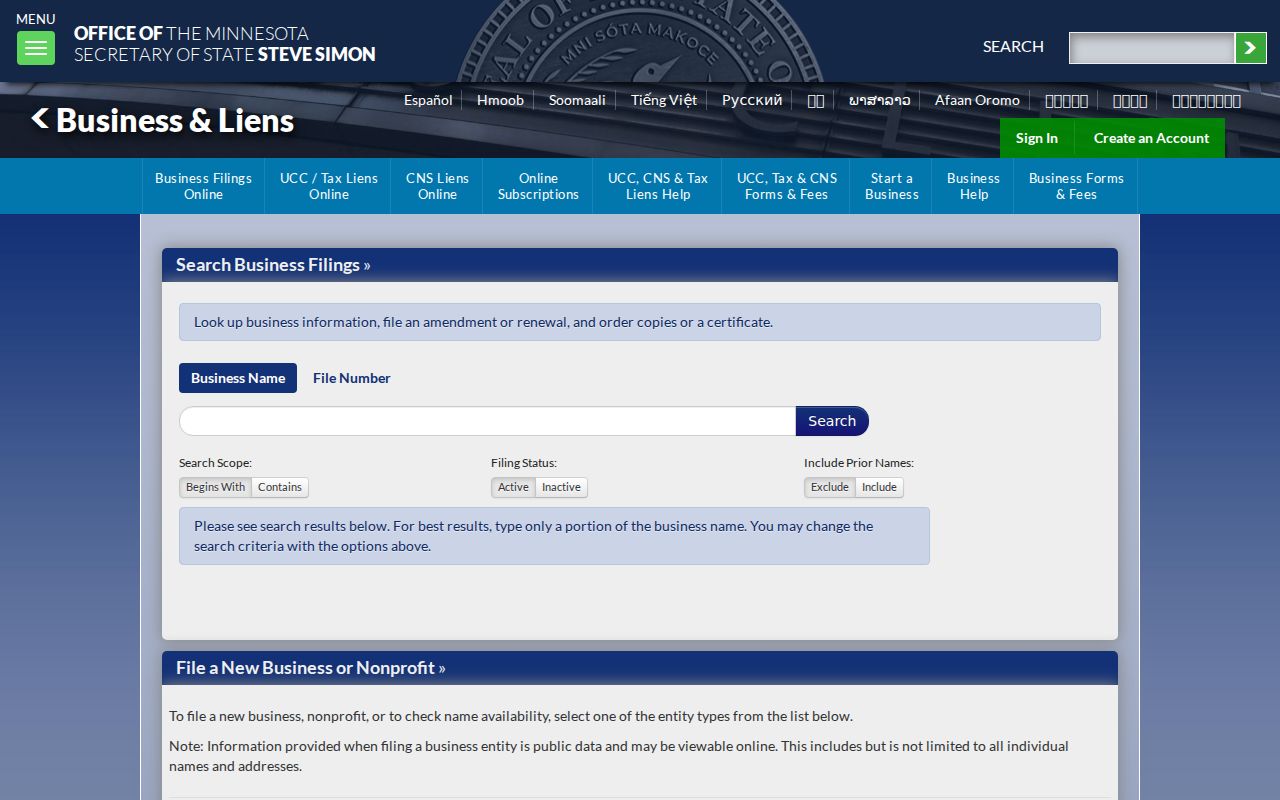
Business filings can corroborate an organization connection, but a filing or registered-agent address should be labeled as that type of record, not assumed to be a personal address.
Eagan Voter Resident Records
Minnesota Voter Status Lookup is a match tool, not a browsable Eagan roster. It requires first name, last name, city or township, house number, and street, plus either ZIP code or county. A unit number is required when the unit box is selected. The result confirms a registration match and gives next steps. The state says it updates nightly, while local processing can take up to 14 days before the change appears.
Minnesota Statutes section 201.091 treats the public voter list differently from the basic form. The public list may include name, residence address, birth year, voting history, districts, and a supplied phone number. It excludes full birth date and identifying numbers. A list request requires identification and a written permitted-use statement. A city, county, district, ward, precinct, or street-sorted walking-list product is available through the official request process, but searchable internet publication is prohibited.
Current Eagan Resident Directory Sources
No official Eagan residents directory publishes every household. Instead, directory-like sources identify different relationships to a place: ownership, a registration confirmation, a filing party, an address-linked city item, or a historical name. The table separates those roles, so a result can be read for what it actually says. For a one-person confirmation across several records, use the focused Eagan resident lookup workflow.
| Record source | Connection shown | Custodian | Access |
|---|---|---|---|
| Property Information | Current owner, parcel, mailing route, tax/building facts | Dakota County | Free portal and public terminals |
| Voter status/list | Registration match or permitted public-list fields | Minnesota SOS and county elections | Address match or restricted request |
| RecordEASE | Parties to deeds, mortgages, liens, and plats | Dakota County Recorder | Login and per-search/document fees |
| OnLama | Address-linked permit, inspection, or city item | City of Eagan | Free basic search, public material varies |
| Telephone directories | Listed name, phone, and street in a historical volume | MNHS | Print or fiche request |
Official sources are usually clearer about the custodian and date. Compiled commercial services can mix old addresses, similar names, and purchased data without showing the source trail. Their broad category can be convenient, but it is weaker than preserving the exact county, court, library, or city record that supports a specific fact.
| Official Eagan record | Compiled commercial result |
|---|---|
| Identifies its custodian, record type, and date | May combine public filings, marketing data, and older address histories |
| Can be checked with the county, city, court, or library | May have stale entries or attach a fact to a similar name |
| Uses the access rules of the original record | Has its own pricing and privacy practices |
Eagan Resident Court Checks
Minnesota Court Records Online, known as MCRO, is the statewide district-court route for Dakota County cases. Its Name tab accepts last, first, and middle names, a Sounds Like option, date of birth or filing-date ranges, categories, status, and a county selector. The other tabs search case number, citation number, and attorney. A public result can supply a case number, filing date, case category, location, party names, status, docket entries, and notices about public documents.
Remote information is not the official court record, and not every file or document appears remotely. For paper files, broader electronic access, or certified copies, use a courthouse public terminal or Court Administration. Juvenile, adoption, sealed, expunged, and other protected material may be unavailable. Confirm a same-name result with a second field such as the court location, date, category, or lawfully visible birth information.
Note: A missing MCRO result does not prove that a person never had a court matter or that every related document is public.
Earlier Eagan Resident Directories
Eagan's strongest verified historical directory collection is a telephone-book run, not a confirmed annual Polk series. The Minnesota Historical Society finding aid documents Eagan print, fiche, duplicate, and yellow-pages-only items from 1964 through 2011. White pages can associate a listed residential or business telephone number with an address. Yellow pages arrange businesses by subject, so they do not establish a household in the same way. The finding aid is an inventory, not a viewer. Request the listed volume or fiche before treating an entry as evidence.
The MNHS telephone-directory finding aid records gaps and special items, including no listed Eagan entry for 1965 and yellow-pages-only material in several later years. For a five-year search, MNHS offers a staff service for one person or business, with City Directories at $10, Telephone Books at $10, or both at $20. The normal turnaround is three to four weeks, with a possible twelve-week wait. The fuller collection and tracing method belong on the Eagan city directory page.
Eagan Resident Record Endpoints
For an endpoint in a historical Eagan search, the MNHS death-record search covers 1904 through 2001. Its fields include first, middle, and last name, death date, county, and certificate number, with Starts With, Sounds Like, Contains, and Exactly options. A result is an index lead. The full record is accessed through MNHS microfilm or the appropriate copy route, and the research notes warn of incomplete data and transcription errors.
The Minnesota Official Marriage System includes Dakota in its county selector and offers applicant-name and date-range searching. It is still an index, not the certificate. Ask the issuing county for an official certificate. Vital records have their own access rules under Minnesota Statutes sections 144.225 and 144.226, and a birth, death, marriage, or court record should never be conflated with a general resident roll.
Eagan ZIP Checks Before Searching
ZIP labels narrow a search but do not define the city. The strongest city-specific evidence supports 55121, 55122, and 55123 as Eagan ZIP choices. USPS's July 2026 notice also says the Eagan Sorting and Delivery Center serves 55118 and 55120 through 55123. That wider facility service area is not a municipal-boundary list. For a single address, verify the delivery ZIP with USPS, then use the parcel municipality field or city boundary map for its civic location.
The USPS Eagan facility record gives useful postal context, while the Dakota County ZIP map is a visual reference. Neither replaces an address-level check. Keep the ZIP, situs address, mailing address, and legal description in separate fields, especially when a historic Eagan street appears under a nearby postal label.
Eagan Historical Resident Records
Older Eagan research crosses township and city eras. Eagan Township was established in 1860, and Eagan incorporated as a city in 1974. Dakota County Historical Society adds sources that modern portals do not: newspaper microfilm back to the 1850s, census materials from 1849 to 1940, plat ownership maps from 1879 forward, church and cemetery material, obituaries, naturalizations, directories, and photographs. Its online record search describes more than 500,000 items, but individual years and item access still need a staff check.
One distinctive Dakota County lead is the Society's 1918 registration index. Its search form uses last name, first name, and birthplace, and a returned row can identify age, residence, city, a note, and a microfilm-roll number. It is not an Eagan household roster, and the research inspection saw a Rosemount example rather than an Eagan person. Still, the result format can point a researcher from a name to a physical roll. Preserve the exact spelling, city, and roll reference, then ask staff to retrieve the underlying material rather than expanding a short index entry into an unsupported family claim.
For an Eagan name that crosses these sources, keep a short chronology: the volume or roll date, the locality label, the address or plat clue, and the custodian. A timeline makes it easier to separate a true household move from a different spelling, a changed record format, or an unindexed gap.
The local setting matters. Eagan grew from an agricultural township, once promoted as the Onion Capital of the U.S., to a city with 68,855 people in the 2020 Census. A 1964 telephone book, a 1971 county map, a 1993 deed-index threshold, and a 2011 directory may reflect very different neighborhoods. The Eagan Historical Society's 1914 Town Hall collections and the Dakota County Historical Society offer the useful local bridge between those eras.
Note: Record the Eagan source's format and year, because a fiche-only entry, an unindexed book, or a custody change can explain a blank online search.
Eagan Resident Privacy Requests
When an online search ends, Minnesota Government Data Practices Act guidance recommends a written request to the responsible authority that identifies the data, date range, address or PIN, and whether inspection, copies, or both are wanted. The agency does not have to create a new list or release nonpublic data. Eagan's policy routes city data questions through the City Clerk and sets a ten-working-day target for a non-immediate response involving individual data. County and state records should go to the custodian that holds them.
Minnesota Data Access guidance explains the statewide request route and copy practices. It also helps distinguish a public record from information that is classified or protected. Safe at Home addresses, protected voter information, private adoption records, and personally identifying details in recorded instruments require special care.
The state guidance outlines how to make a public-data request and receive a response. It is an important fallback when a published Eagan residents directory source has a coverage gap.
Ask for the smallest record set that answers the question, then verify any released record with the office that keeps it.